
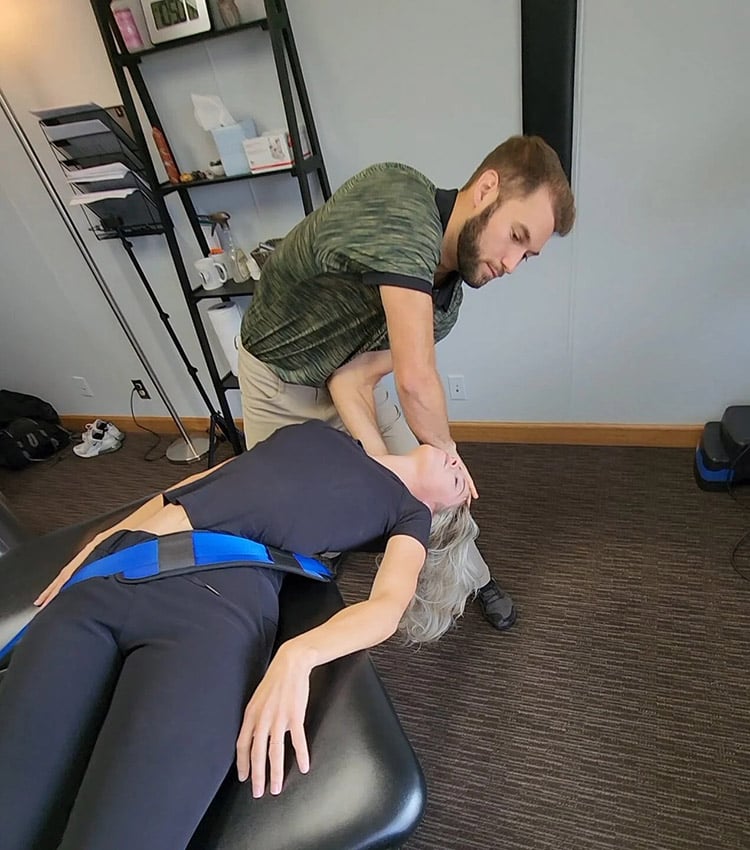
Summary: A chiropractor evaluates problems affecting the spine, joints, muscles, and movement, then develops care based on your symptoms, health history, and examination findings. Chiropractic care may include spinal adjustments, mobility work, soft tissue techniques, exercise, and other approaches depending on your individual needs.
Key Takeaways:
- Chiropractors assess musculoskeletal problems rather than simply performing spinal adjustments.
- Chiropractic care may involve several techniques, including spinal manipulation, soft tissue therapy, exercise, and mobility work.
- Research suggests spinal manipulation can provide modest improvements in pain and function for some people with low-back pain.
- The right treatment and visit frequency depend on the person’s symptoms, health history, examination findings, and response to care.
Back pain, stiff necks, and recurring headaches are more than everyday annoyances for many adults across the St. Croix Valley. It can change how you move through everyday life.
Many people live with these problems for weeks or months before deciding to see a top chiropractor. Others are interested in chiropractic care but are not sure what a chiropractor does beyond spinal adjustments.
A chiropractor is a licensed health professional trained to diagnose and treat problems involving the spine, joints, muscles, and nervous system. Instead of relying on prescriptions, they use drug-free, hands-on care to restore movement, ease tension, and support the body’s natural ability to heal. For anyone who would rather not lean on medication, the approach is well worth considering.
If you are considering the top chiropractor in Hudson, WI for chiropractic care, here is what you can expect.
What Is a Chiropractor?
Chiropractic care is a hands-on, drug-free approach to treating pain and improving how the body moves. At its core, a chiropractor diagnoses and treats problems connected to the spine, nervous system, and the muscles and joints supporting them.
A great deal of this work involves spinal health. The spine houses the nervous system and plays a part in almost every movement. When its joints or nearby tissues stop moving properly, pain and stiffness tend to follow. A chiropractor examines how these parts function together to pinpoint where the problem starts.
Every treatment plan begins with an assessment of your symptoms, health history, and physical condition. From start to finish, the emphasis stays on restoring function and managing pain in a lasting way.
How Chiropractic Care Differs from Other Pain Treatments
The clearest difference is the hands-on, non-invasive nature of the care. Rather than turning to medication or surgery, a chiropractor uses adjustments, joint mobilization, and soft tissue techniques to ease discomfort directly.
Equally important is the attention paid to how movement and musculoskeletal health connect. When the body moves poorly, joints and muscles absorb added strain. Correcting those patterns can relieve pain at its source instead of simply covering up the symptoms.
They also look at how different parts of the body interact. Restricted movement in the hips, for example, may affect how someone moves through the lower back. Tight muscles or reduced joint motion may also change how a person bends, turns, lifts, or exercises.
Chiropractic care can also work alongside treatment from other healthcare providers when a patient’s condition calls for it.
What This Means For You: If pain in one area of your body seems connected to stiffness or weakness somewhere else, that's exactly the kind of pattern a chiropractic evaluation is designed to identify.
|
What May Bring Someone to a Chiropractor?
Some patients come in because of a specific injury. Others have pain that keeps returning, stiffness after long workdays, or reduced mobility that makes exercise or daily tasks harder.
You do not need to know exactly what is causing the problem before booking an assessment. Part of the chiropractor’s job is to evaluate the symptoms and determine whether chiropractic treatment is an appropriate option.
Reader Scenario: If you're someone who sits at a desk all day and notices stiffness by mid-afternoon, or who's started avoiding certain movements because you expect them to hurt, these are common reasons people book a first chiropractic assessment. |
What Happens During Your First Chiropractic Appointment?
Your first appointment gives the chiropractor time to learn what you are experiencing before recommending care.
At Hudson Spine & Health, things start with a bit of paperwork, followed by a one-on-one consultation. Our chiropractor takes time to talk through your health concerns, the challenges you’re facing, and what you’re hoping to get out of care before moving on to a physical evaluation.
From there, the examination may include a look at your spine, reflexes, posture, and range of motion, along with other orthopedic, neurological, and physical checks. What you’re offered is based on your situation.
It helps to come prepared. Be ready to talk about any past injuries, current symptoms, medications you’re taking, treatments you’ve already tried, and the activities that seem to make your discomfort better or worse. If the clinic has asked for medical records or imaging, bring those along too.
Tip: Jot down your symptoms and questions before your appointment, it's easy to forget details once you're in the exam room. |
Will You Receive Treatment on the First Visit?
In most cases, yes. Hudson Spine & Health’s current first-visit process includes treatment right after the examination. Depending on what the exam reveals, it might mean chiropractic care, stretching, trigger point release, or another technique suited to your needs.
That said, the examination always comes first. Your chiropractor needs a clear enough picture of what’s going on to know which type of care fits your condition, and whether any further evaluation makes sense before moving ahead.
Pain and Conditions Chiropractic Care May Address
Chiropractors commonly work with musculoskeletal problems involving the back, neck, joints, muscles, and related tissues.
Hudson Spine & Health’s chiropractic services cover a wide range of concerns, including back pain, neck pain, sciatica, headaches and migraines, hip and knee pain, herniated discs, pinched nerves, sprains and strains, work injuries, whiplash, shoulder pain and other joint or extremity issues.
Some of the more common reasons people come in for an assessment include:
- Lower, middle or upper back pain
- Neck pain or stiffness
- Sciatica symptoms
- Headaches where musculoskeletal factors may play a role
- Shoulder, hip or knee discomfort
- Muscle tightness and strains
- Sports-related discomfort
- Work-related pain
- Restricted range of motion
- Trouble moving comfortably after an injury
It helps to be clear about what chiropractic care can and can’t do. It isn’t a cure. What it can do is help manage pain, improve mobility, and support better everyday function, with results depending on the cause of your symptoms and how your body responds to care.
Common Mistake: Expecting chiropractic care to "fix" a problem permanently in one visit. Depending on the condition, care may involve more than one visit along with exercises, mobility work, or other recommendations to support recovery. |
When Should You Consider Seeing a Chiropractor?
Consider an assessment when pain keeps returning, lasts longer than expected, or starts limiting what you can do.
Maybe turning your head while driving has become uncomfortable. Perhaps you notice stiffness every morning, or catch yourself avoiding certain movements because you already expect them to hurt.
Changes like these are a signal worth listening to. Rather than working around the problem repeatedly, it may be time to have it properly assessed.
Signs To Watch For: Pain that keeps returning, morning stiffness that doesn't ease up, or avoiding certain movements out of habit are all signs worth having assessed. |
Chiropractic treatment isn’t limited to a single technique.
Spinal adjustments are one of the most familiar methods. Here, the chiropractor applies controlled movement or force to specific joints, guided by what the examination reveals. Different adjustment techniques may be used depending on your condition, comfort level, and treatment goals.
Hudson Spine & Health also offers soft tissue therapy, including massage and the Graston Technique, along with spinal decompression, rehabilitative exercises, and postural guidance as part of its chiropractic care.
Each of these serves a purpose.
- Stretching and mobility work can help ease restricted movement.
- Rehabilitation exercises may focus on building strength, flexibility, or control.
- Spinal decompression might be considered for certain patients with disc-related or sciatic symptoms, once an appropriate evaluation has been done.
Essentially, no single technique is right for everyone. Whatever treatment is used should tie directly back to what the assessment uncovered.
How It Works: Spinal adjustment uses a controlled movement or force applied to a specific joint, with the goal of improving joint motion and reducing discomfort. The technique and amount of force used depend on the patient's condition, examination findings, and comfort level. |
Here’s a quick side-by-side look at how these techniques compare:
| Technique | What It Does | Often Used For |
| Spinal Adjustment | Applies controlled force to a joint to restore motion | Joint stiffness, restricted spinal movement |
| Soft Tissue Therapy (incl. Graston Technique) | Targets muscle tightness and scar tissue | Muscle tension, strains, recovery from injury |
| Spinal Decompression | Gently stretches the spine to relieve pressure | Disc-related or sciatic symptoms |
| Rehabilitative Exercise | Builds strength, flexibility, and control | Long-term mobility and injury prevention |
| Postural Guidance | Corrects movement and positioning habits | Desk-related stiffness, recurring strain |
No single technique on its own defines chiropractic care, which one applies to you comes down to what your exam reveals.
Could Chiropractic Treatment Be a Good Fit for You?
Chiropractic care may be worth considering if musculoskeletal pain, stiffness, or limited mobility is getting in the way of your normal routine.
Your medical history still plays an important role. Previous surgeries, injuries, bone health, neurological symptoms, medications, and other health conditions can influence which treatments are appropriate for you.
In some cases, a chiropractor may spot symptoms calling for a different type of medical evaluation. A referral to another provider doesn’t mean chiropractic care has failed. It simply means the symptoms need a different form of assessment or treatment.
It also helps to set practical expectations. Your goal might be less pain, easier movement, better range of motion, or finally getting back to an activity you’ve been avoiding. Treatment won’t produce the same result or follow the same timeline for everyone.
Before You Decide: Share your full medical history, including past surgeries, injuries, medications, and any neurological symptoms. This information can help your chiropractor determine whether chiropractic care is appropriate or whether another type of medical evaluation should come first. |
When Can You Expect to Notice a Difference?
There’s no set number of visits before someone notices a change.
A recent muscle or joint problem can behave very differently from pain that has lingered for months or years. Progress may also depend on the underlying cause, how severe your symptoms are, your activity level, your general health, your work demands, and what you do between appointments.
Instead of measuring progress solely by whether the pain is gone, pay attention to function too. Can you turn your neck a little farther? Can you sit through a workday more comfortably? Are you moving more freely during exercise? Are the activities that used to aggravate the problem starting to feel easier?
Your chiropractor can use these kinds of changes to decide whether your treatment plan should continue as is or be adjusted.
Did You Know: Two people with the same diagnosis can respond to care at very different rates. That's why changes in function, mobility, and day-to-day activities can be useful alongside pain levels when evaluating progress. |
Why Consistency Is Important
Appointments are only one part of the overall care.
If your chiropractor gives you mobility exercises, strengthening work, stretches, or adjustments to make at your workstation, following through on those recommendations helps support the progress made during your visits.
Regular reassessment is important, too. Checking in on how you’re responding allows your chiropractor to fine-tune the plan over time.
Tip: Treat recommended home exercises as part of your overall care rather than an optional extra. Following your chiropractor's recommendations between visits may help support mobility, strength, and progress toward your treatment goals. |
Get Clear Answers About Your Pain and Movement
Seeing a chiropractor is not simply about getting your back adjusted. It starts with figuring out what hurts, how the problem affects your movement, and which treatment options make sense based on the examination.
For patients looking for chiropractic care in Hudson, WI, Hudson Spine & Health provides chiropractic adjustments alongside soft tissue techniques, spinal decompression, rehabilitation, and other supportive therapies based on patient needs.
If pain or limited mobility keeps interfering with your work, exercise, or everyday routine, schedule an evaluation with Hudson Spine & Health. A thorough assessment can give you a clearer idea of what is contributing to the problem and what your next steps may look like.
Next Step: If pain or stiffness has been limiting your routine, consider scheduling an assessment. An examination can help identify possible contributors to your symptoms and determine which treatment options, if any, may be appropriate for your situation. |
Frequently Asked Questions (FAQs)
1. Do I need a referral to see a chiropractor in Wisconsin?
- In general, you can schedule chiropractic care in Wisconsin without first getting a physician referral. Wisconsin insurance rules also state an insurer may not require a physician referral simply for someone to receive covered chiropractic benefits.
2. Is chiropractic care covered by insurance?
- Coverage depends on your insurance policy and the services you receive. Wisconsin requires certain health policies to cover services from chiropractors when the same covered service would be payable if performed by a physician or osteopath. Check your specific benefits before treatment.
3. How often should you see a chiropractor?
- There is no schedule that works for everyone. Visit frequency depends on your symptoms, examination findings, treatment goals, and response to care. Your chiropractor should explain why a certain schedule is recommended and reassess it as you progress.
4. Does a chiropractor crack your back?
- A chiropractic adjustment may produce a popping or cracking sound, but the sound itself is not the treatment. It can occur when gases within a joint shift during movement. Some adjustment techniques produce little or no sound at all.
5. Are chiropractic adjustments safe?
- Spinal manipulation can cause temporary soreness or discomfort, and serious complications have been reported, although research suggests they are uncommon. A 2023 systematic review of randomized trials involving 7,518 participants reported no serious adverse events in the included studies, while also noting inconsistent adverse-event reporting across trials. A health history and physical assessment help your chiropractor decide whether a particular technique is appropriate for you.
6. What does a chiropractor do for back pain?
- A chiropractor first looks at possible factors contributing to your back pain, such as joint movement, muscle tension, mobility, posture, or injury history. Treatment may then include adjustments, soft tissue techniques, decompression, exercise, or movement recommendations based on the findings.
7. What does a chiropractic adjustment feel like?
- Most adjustments involve a brief, controlled movement at a joint. You may feel pressure, stretching, or a quick movement. Some people hear a popping sound. Tell your chiropractor if a position or technique makes you uncomfortable so they can discuss other options.
8. Can a chiropractor help with neck pain or headaches?
- Chiropractors may treat some forms of neck pain and headaches, particularly when muscle tension, joint movement, or other musculoskeletal factors are involved. The first step is an assessment to determine what may be contributing to your symptoms and whether chiropractic care fits your situation.